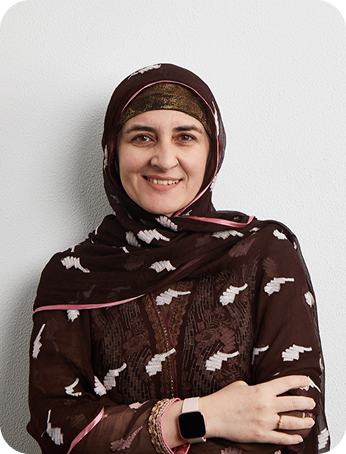
This month, we interviewed Dr Faiza Khan for our Member Story, a regular feature in our newsletter where we shine a spotlight on the passionate individuals that make up our member base.
If you would like to share your story, please email the Marketing team at [email protected]
1. What did you want to be when you were young?
I had always wanted to be a doctor from a very young age. I think I would declare that to everyone who would care to listen to me (or not!) It was also my mother’s dream.
2. Describe your medical journey.
My mother passed away when I was 17 and I couldn’t give my A-levels exams until later that year. I still can’t understand how I studied and gave my exams within months of her passing but my state of mind was very much like ‘either this happens or it doesn’t.’ I applied to just one medical college without any plan B and thankfully got in.
During internship I decided to pursue surgery and got in the surgical training program. I left the program after being disillusioned by two main factors: discrimination against women in surgery especially being a woman of colour from a foreign country and the toxicity of the thankless work culture that pervaded surgical training. Undecided about my future I opted to join the general practice training program and surprisingly found it to be a very rewarding experience despite the bone wearing red tape and paperwork.
There were two patients who changed the course of my journey during my GP training, both diagnosed with terminal cancer. One of them chose to ‘suffer and only acknowledge death without any relief offered by the palliative treatment’ and the other chose to ‘accept the illness, the inevitability of death as an expected outcome rather than a punishment.’
Their journeys and experiences were completely different and taught me the importance of one’s perspective and mindset in defining growth and resilience in the face of life’s harshest adversities. Personally, I had been scarred by my mother’s death and finding myself at the centre of their ‘end of life care’ proved to be cathartic and therapeutic for me in many ways. I also learnt that dealing with death, trying to understand what we go through when we face it unexpectedly or through old age was not something we can learn through curricula or courses.
3. Your first patient interaction – what did you learn from this experience?
A few patient interactions during internship remain very close to my heart. I saw a lot of death and disability and discovered that the difference a sensitive and compassionate treating team brings in people’s lives was truly remarkable. I think the seed for being a doctor that can ‘see one through a time where medicines and interventions might not be able to offer much’ was definitely planted in that first year of clinical training for me. Even though I haven’t seen many patients like them since that time but they definitely set me on the path of helping people ground and anchor themselves in the face of everyday challenges and major life events.
4. Why is Psychological Medicine a passion area for you?
Psychological medicine taught me to recognise how childhood relationships and interactions shape people and their outlooks on life. Helping them tell their stories and learning to listen and make sense of them has been truly gratifying. Learning to reflect without judgement, acknowledging our ‘humanness’ and developing the skills to see ‘the whole person’ has been deeply fulfilling for me personally and professionally.
5. Why were you drawn to ASPM?
ASPM felt like my tribe and made me feel like I had come home after a long tumultuous journey. I thank Susan Barnette with all my heart for recommending ASPM to me when I met her at a workshop.
6. Psychological Medicine in general practice is hard work. Can you offer a word of advice/support for fellow mental health doctors?
Word of advice to our fellow ASPM members is to respect themselves and value their work and well-being as much as they value the well-being of their patients.